
Who were the Rechabites? Upon receiving the Polaschek Medal, we discovered several Rechabite Medals among them. Diana Humm, one of our volunteers, conducted research and identified a Canterbury citizen soldier who was a member of the Rechabites.
by Jim Frew
The Independent Order of Rechabites (IOR), also known as the Sons and Daughters of Rechab, is a fraternal organisation and friendly society founded in Salford, England in 1835 as part of the wider temperance movement to promote total abstinence from alcoholic beverages. They were an offshoot of the Calathumpians, then a diverse collection of social reformers of independent religious views.
Membership was open to all who would sign “The Pledge” to completely abstain from alcohol except for religious or medical purposes. From the late 18th century a number of Friendly Societies had been set up to help working-class people with such things as health insurance and death benefits. The initials "IOR" on a tombstone may indicate that the deceased was a member of the organisation.
Their first lodge was "Tent Ebenezer No.1" and they soon had separate "tents" for men, women and children. In describing the heritage of the Independent Order of Rechabites, a circa 1892 newspaper in Leeds said:
“If any order in the world has a claim to call itself an Ancient Order it is that of the Rechabites. As we learn from the Scriptures, a command was laid over 2,700 years ago upon the sons of Jehonadab (or Jonadab), the son of Rechab; that they should drink no wine, neither they nor their sons forever; and the injunction has been obeyed to this day.
The rituals and ceremonies of the Rechabites vary from place to place but the order promoted three degrees, Knight of Temperance, Knight of Fortitude, and Covenanted Knight of Justice. Lodges are called tents because Jehonadab commanded the Biblical sons of Rechab to live in tents (Jeremiah 35:6-7).
Each Tent is ruled by a High Chief Ruler, assisted by a High Deputy Ruler, Corresponding Secretary, Sick and Tent Stewards, Inside and Outside Guardians, a Levite of the Tent and a number of Elders.
Membership of the order spread around the world including the United States, Canada, South Africa, Australia and New Zealand. The Order was known to be active in Tasmania since 1843. The Bung Bong “Tent No. 138” was established in rural Victoria in 1876. The building was also used for community purposes including meetings of the Farmers Club and as a Church of England.
In 1991, IOR Victoria combined with the IOR in other states to form a national private health fund. Members wishing to join IOR's health fund were no longer required to sign a pledge of abstinence from alcohol. In 2005 the IOR health fund was sold to HCF Health Insurance, and the rest of the organisation continued as a temperance promoting organisation. In 2008, 38.5 million dollars of its funds management was transferred to the Foresters Friendly Society (a British friendly society which was formed in 1834 as the Ancient Order of Foresters. It was created to provide financial security (insurance/savings) and mutual support to members, widows, and orphans.) As of 2024, the Independent Order of Rechabites retains a state branch in Victoria, with a number of affiliated tents.
Since 2004 the Rechabite Friendly Society has traded as Healthy Investment, a financial services organisation that continues to specialise in providing ethical savings and investment products, not restricted to teetotallers.
Here in New Zealand, there was a short-lived branch of the order in Nelson from 1843. The order was re-established in Auckland in 1863. By 1913, there were two districts in New Zealand – No. 84 District, based in Auckland, and the Central District No. 86, based in Wellington. By August 1997, there were still 98 lodges operating in New Zealand. A specific, historically significant branch, the Unity Tent No. 18 in New Plymouth, closed in 2007. Here in Christchurch, we had the No. 26 Tent, the Pride of Christchurch, which was instituted in July 1877 and was still operating up until at least WW2.
Medals
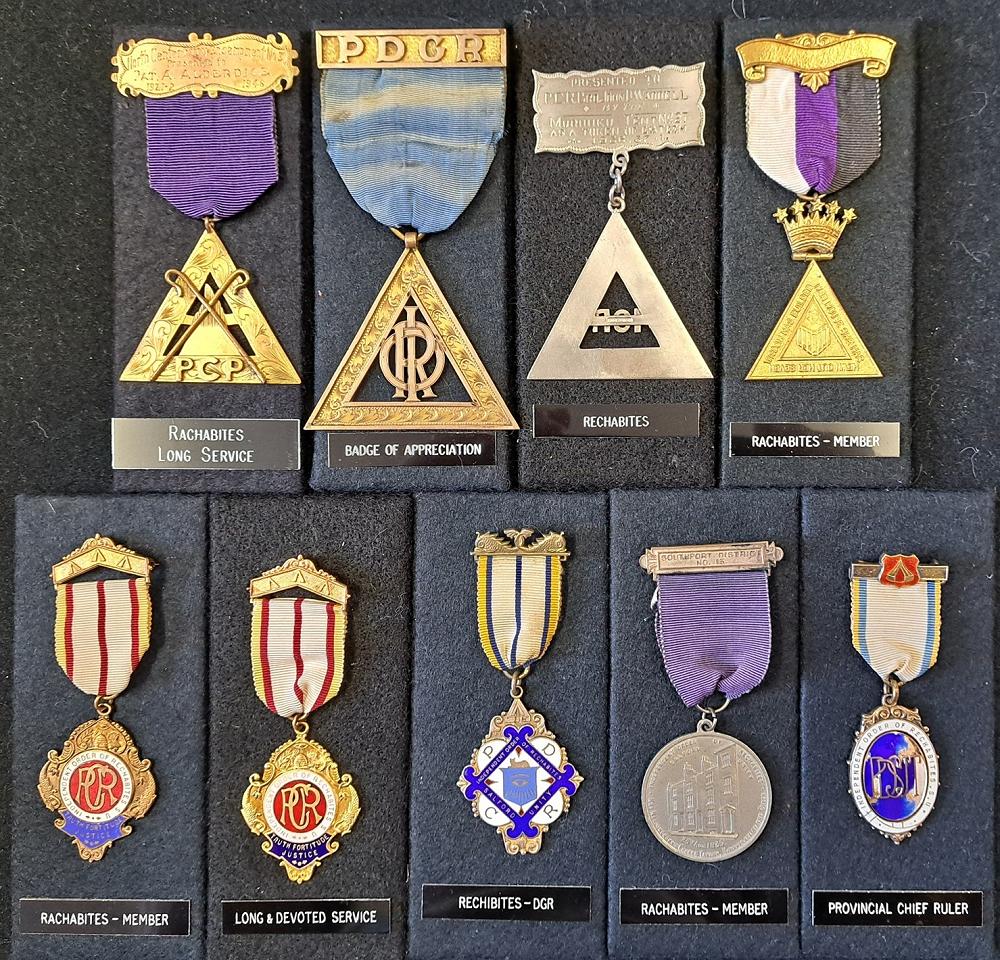
We have several Rechabite medals in our museum collection. Note the triangular shape in the middle which presumably represents “a tent”. The Rechabite medals are commemorative and award medals, issued by the Independent Order of Rechabites (IOR). These medals were given to members for service, sacrifice, or milestones, such as the "For Service and Sacrifice" medal for World War I veterans or a "Rechabite Jubilee" medal for a 1885 jubilee event. The medals feature Rechabite symbols, including a lidded eye, bee skep, wheat sheaf, and a crossed sword and flame, representing purity, hard work, and truth. They were often made of silver or bronze with enamel and colourful ribbons of silk or silk brocade in various colours, often yellow, red, and white, representing purity and the order's values. The central part of many medals features the IOR monogram (PCR for Past Chief Ruler) and the name of the order. They were produced and manufactured by makers such as W.J. Taylor of London or Fattorini of Yorkshire & Bimingham. The Medals were issued for the following purposes:
Temperance and Abstinence: The IOR was a temperance movement society founded on the biblical principle of abstinence from alcohol.
Service and Sacrifice: Medals like the "For Service and Sacrifice" medal were awarded to members who served in World War I.
Commemoration: Other medals commemorate events such as the 1885 jubilee or personal service, like the 1873 medal presented for valuable services.