
In 1964, the Royal New Zealand Infantry Regiment was formed. In the South Island, two new Territorial Force battalions emerged – the 2nd Battalion (Canterbury, Nelson, Marlborough, West Coast) and the 4th Battalion (Otago and Southland). The respective Commanding Officers (Murray Stanaway and Robert Barton) had both served with their predecessor units (the Canterbury Regiment and the Otago and Southland Regiment), although both had different routes to command. In this issue, we profile Murray Stanaway.
—
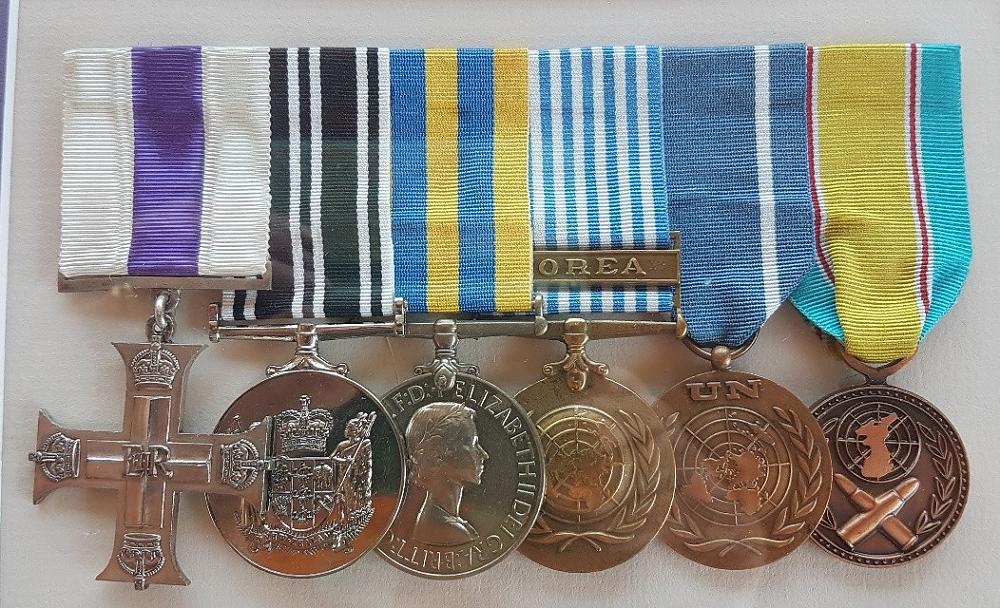
Murray Stanaway was awarded the following medals: Military Cross; Operational Service Medal; Queen’s Korea Medal;
United Nations Service Medal for Korea; United Nations Truce Supervision Organisation Medal;Korean War Service Medal.
[It is considered that he is also eligible for the New Zealand Defence Service Medal, and this will be pursued on behalf of his family who hold the original medals.]
Early Life
Murray Clifford Stanaway was born on 4 February 1929 in Te Kopuru, south of Dargaville on the Wairoa River in Northland. He attained University Entrance during his schooling and a Trained Teaching Certificate, and began a teaching career in the Nelson district. He was teaching at Waingaro (Hamama) School in Golden Bay when he was attested into the New Zealand Army on 29 August 1950 as a Gunner in the Artillery. In September 1950, he commenced a ‘Kay Force OCTU’ course at Trentham, from which he was commissioned as a 2nd Lieutenant, temporary Lieutenant on 13 November 1950.
On Active Service
He was posted to active service with 16 Field Regiment on 1 December 1950 and, as a Lieutenant, embarked on HMT Ormonde – a ship which had served as a troopship in both World Wars – bound for Korea. He served in 163 Battery of the Regiment for almost two years and an extract from his Military Cross citation notes that:
‘During this time, he held all officer appointments in the battery up to troop commander.
He commanded Easy Troop for six months. Even as a Lieutenant, Captain Stanaway was selected as a forward observation officer on many patrols across the River Imjim. He was also a forward observation officer in the Commando battle of October and November 1951. In all these operations, he displayed coolness and courage under the most difficult and trying conditions.
As a troop commander, he was an observation post officer in the line for more than four of the past six months. In support of 3rd Battalion Royal Australian Regiment, his work as an observation post officer was outstanding and won him the high respect and
admiration of the supported battalion. His value to his Battery Commander was very great indeed. During this period, the 3rd Battalion Royal Australian Regiment had two company-sized probes, several smaller ones and many patrol contacts. The Battalion also carried out one company and one platoon raid. Captain Stanaway took part as an observation post officer in each of these actions.
His outstanding characteristic was his personal courage. Under heavy shell and mortar fire, he continued to call down fire and to pass back valuable information. During one action, his observation post was directly engaged by heavy machine gun fire, and nearly 500 shells fell around his observation post. Despite this, he continued giving support, passing information and even passing shelling reports. This was merely one example of how he subordinated all thought of himself to that of giving support to the infantry.’
He was promoted to temporary Captain with effect from 19 June 1952 as a Gun Position Officer and Troop Commander, later becoming a substantive Captain on 19 September 1952. He ceased to be on active service on 18 December 1952 and returned to New Zealand by civil air from Japan. On return to New Zealand, he was granted leave comprising 12 days overseas leave, 56 days annual leave as well as four days for statutory holidays, which ended on 1 March 1953 when he was posted to the Reserve of officers. In 1953, he also met and married Kay.
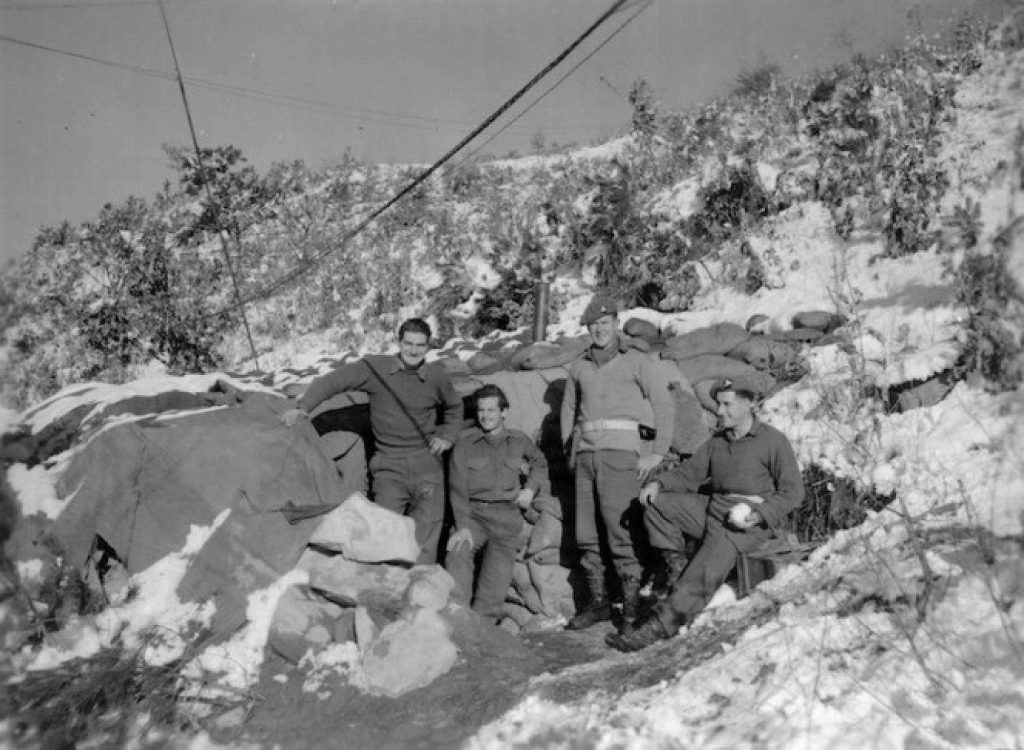
Murray Stanaway (standing, centre) with his gunners in Korea.
From Gunner to Infantryman
He returned to his pre-Korea role of teaching with postings to Neudorf School (now the Upper Moutere School), then Grovetown and, later, Burnham. In 1956, while at Neudorf School, he was transferred to the Territorial Force as a Captain in the 1st Nelson, Marlborough and West Coast Regiment with seniority dating from 25 August 1956. At the Annual Camp in Tekapo in 1957, he is recorded as commanding A Company and, as a Major, commanded the 100-man guard when the Freedom of the City of Nelson was granted in 1958.
Between 1957 and 1962, he qualified on various Army courses including Captain to Major Administration and Military Law, Captain to Major Corps (infantry), Captain to Major Tactics, TF Officers NBC course, and Major to Lieutenant Colonel Tactics course.
In October 1961, an Army reorganisation reduced the number of battalions in the Territorial Force, with 1 NMWC losing its unit status and becoming a regimental depot of the 1st Canterbury Regiment. Both the Canterbury Regiment and the NMWC Regimental Depot retained two rifle companies each and, as a precursor to what was to occur in the next few years, they attended annual camps as one infantry battalion. In 1962, Murray Stanaway had been appointed as headmaster of the Burnham Camp School and, on 1 April 1962, as a Major (temporary Lieutenant Colonel), he was appointed Commanding Officer of 1st Canterbury Regiment, his rank being substantiated on 31 August 1962. Later the same year, he was appointed as an Honorary Aide-de-Camp to the Governor-General, a position usually held by the senior unit commander in each region.
In October 1963, the Army announced another reorganisation of the infantry units, with all battalions – regular and territorial – coming under one regiment, the Royal New Zealand Infantry Regiment. The Canterbury and the NMWC Regiments were to be formally amalgamated to become the 2nd Battalion of the Royal New Zealand Infantry Regiment, short title 2 RNZIR and, in early 1964, Murray Stanaway was appointed as Commanding Officer of the new 2 RNZIR. Later, the name was changed slightly to reflect the historical predecessors – 2nd Battalion (Canterbury, Nelson, Marlborough and West Coast) Royal New Zealand Infantry Regiment, with the short title 2 Cant NMWC. Although the Commanding Officer and many of the large Regular Force cadre staff lived in Burnham Camp, it was decided to move the Battalion Headquarters to King Edward Barracks in Christchurch.
United Nations Service
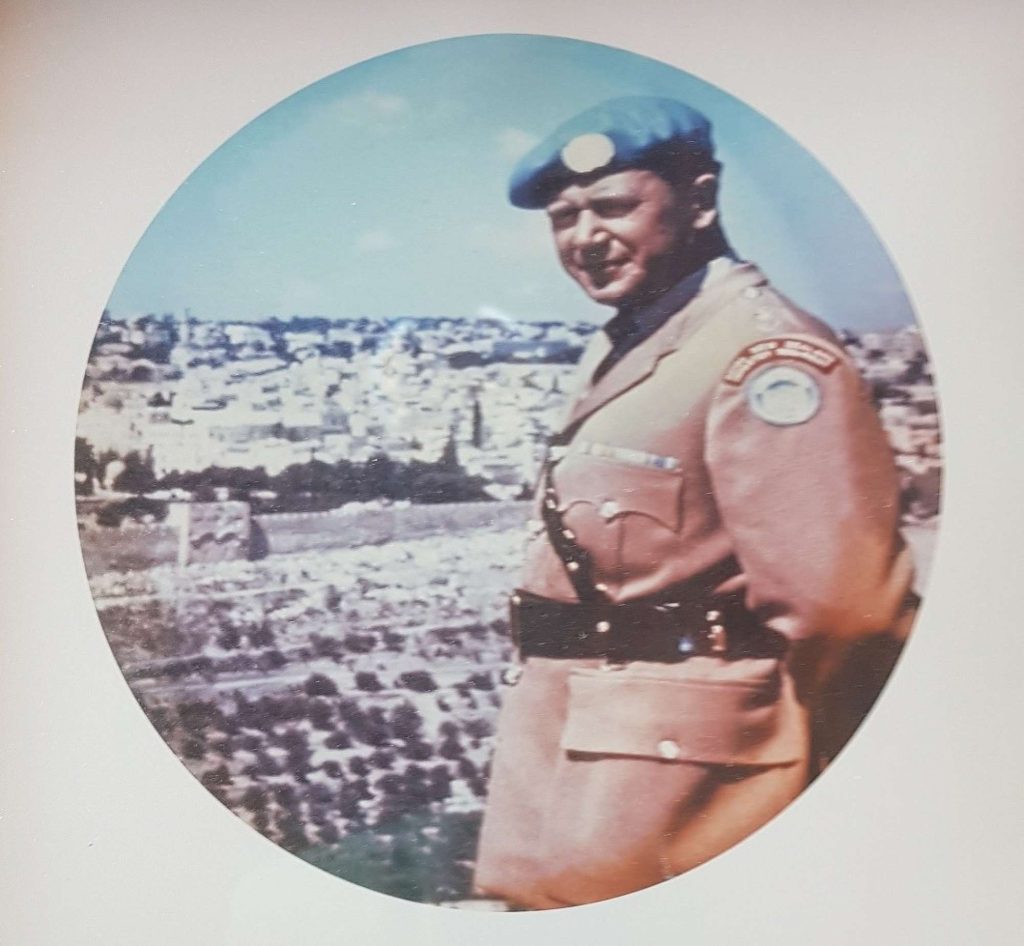
In May 1964, discussions were held about his being appointed as a United Nations observer in Palestine and, in June 1964, this was confirmed with a start date of July, when he relinquished the appointment of CO 2 RNZIR and was appointed to the United Nations Truce Supervision Organisation. His wife and three children, aged 10, 8 and 7, joined him in November 1964, at his expense, as it was an unaccompanied posting. In 1965, he was responsible for the administration of the Mount Scopus demilitarised zone and, later that year, was appointed as the Chairman of the Mixed Armistice Commission in Jerusalem, responsible for a staff of 40 senior officers from various countries as well as civilian employees.
His initial two years’ posting was extended by 12 months and his family returned to New Zealand in June 1967, having been evacuated to Cyprus due to the six-day war in June 1967. After the UN requested a further extension for him, he remained in the post until April 1968, and took on another role as head of the liaison office in Amman, Jordan when Jerusalem could no longer serve as a viable meeting location.
In April 1968, he returned to New Zealand and was released from his Regular Force engagement and, after a long period of leave, he was posted to the Reserve of Officers in September 1968. In May 1969, he requested that he be released from the Reserve due to the fact that he intended to work overseas for more than six months. He had been appointed as assistant resident representative of the United Nations Development Programme in Lusaka, Zambia.
On 14 July 1970, he was travelling by road with his son and a colleague to watch the All Blacks play Rhodesia in Salisbury when they were involved in a vehicle accident. Murray Stanaway and his colleague were both killed while his son suffered serious head injuries. He was cremated and his ashes returned to New Zealand, where they are reposed with a plaque in the Nae Nae Cemetery in Wellington.
Murray Stanaway was awarded the following medals:
Military Cross; Operational Service Medal; Queen’s Korea Medal; United Nations Service Medal for Korea; United Nations Truce Supervision Organisation Medal;
Korean War Service Medal.
[It is considered that he is also eligible for the New Zealand Defence Service Medal, and this will be pursued on behalf of his family who hold the original medals.]